
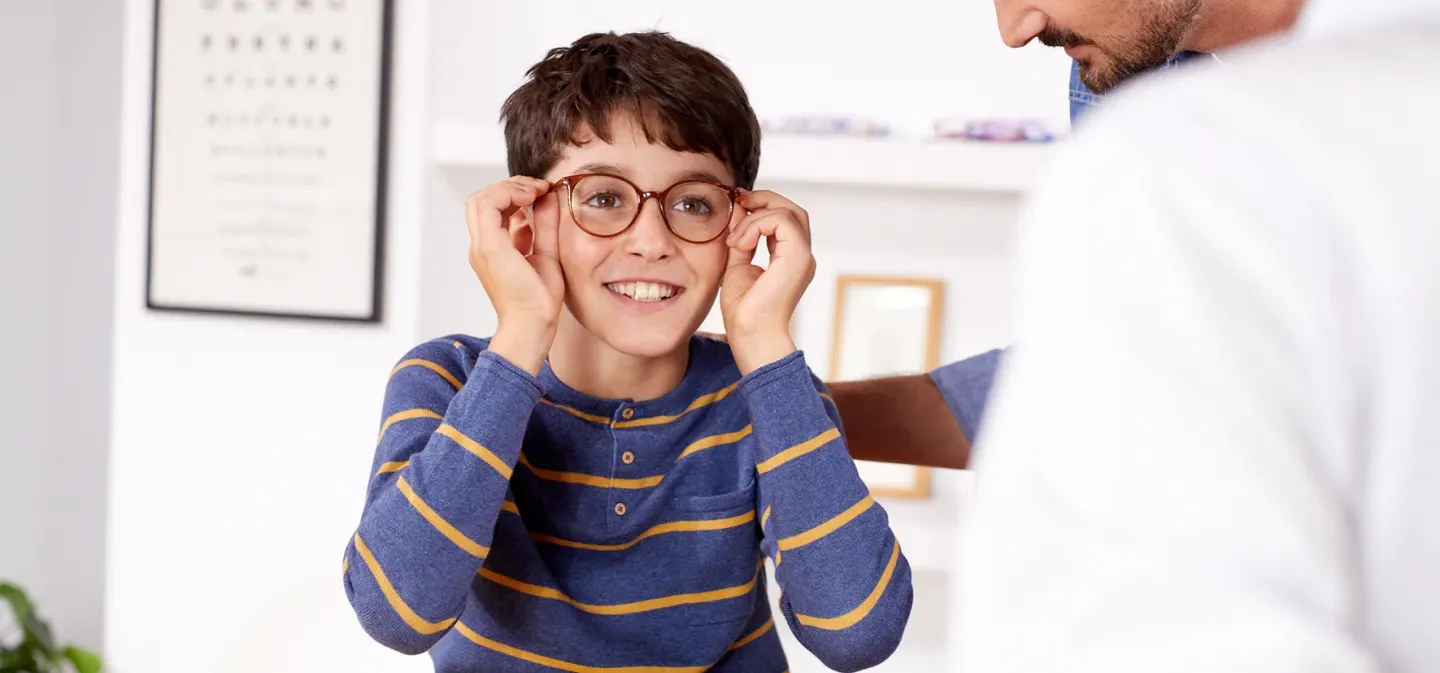
You may have seen SightGlass DOT™ lenses mentioned online as one of the newer options for slowing childhood myopia. Here’s an honest look at how they work, what the evidence actually shows, and why Stellest and MiyoSmart iQ remain the lenses I reach for today.
If you’ve been researching myopia control for your child, you’ve probably come across SightGlass DOT (Diffusion Optics Technology) lenses somewhere in your reading. They’re generating a lot of interest internationally, and for good reason: the clinical results are genuinely solid. But there are two things worth knowing before you go looking for them locally. They aren’t sold in Australia yet, and depending on your child’s needs, one of the lenses I already dispense may serve them just as well, or better.
What is a SightGlass DOT lens?
Most myopia control spectacle lenses on the market, including Stellest and MiyoSmart, work on a defocus principle. Tiny lenslets bend light so that it focuses slightly in front of the retina at the periphery, which is thought to send a “stop growing” signal to the eye.
SightGlass DOT lenses take a different route entirely. Instead of manipulating focus, they’re built around a contrast theory of myopia: the idea that overly sharp, high-contrast images on the retina may drive the eye to elongate. The lens contains thousands of microscopic light-scattering “dots” spread across its surface, gently softening contrast across the whole visual field while keeping central vision clear enough for everyday tasks.
In plain terms: Defocus lenses (Stellest, MiyoSmart) change where light focuses. DOT lenses change how much contrast reaches the retina. Both are trying to slow the same process, axial elongation, from two different scientific angles.
Where you can (and can’t) get them
This is the part most blog posts skip over. SightGlass DOT lenses are commercially available in a growing number of countries, but Australia isn’t one of them yet.
Current commercial availability: Canada, China, Israel, Netherlands, Spain, United Kingdom. Australia: not yet available.
SightGlass Vision has stated it remains committed to expanding into more markets over time, but there’s no confirmed timeline or TGA listing for Australia at present.
In practice, this means the lens isn’t something I can order in for a child at Carina Eye Care today, and I’d be cautious of anywhere claiming otherwise, or of grey-market imports without local regulatory oversight or manufacturer fitting support.
What the evidence actually shows
SightGlass DOT lenses have one of the more mature evidence bases among the newer designs, anchored by the ongoing CYPRESS trial (North America) and the CATHAY trial (China).
Efficacy at 12 months, across two populations
Anecdotally, several colleagues who prescribe DOT lenses in majority-Asian practices have mentioned it seems to control myopia more effectively in Asian children than the original first-generation MiyoSmart and Stellest lenses did in the same population. That observation lines up loosely with the trial data above, though it’s worth remembering it’s clinical impression rather than a formal head-to-head comparison, so it’s a good conversation starter with your optometrist rather than a hard rule.
Longer-term data is also reassuring: 4-year CYPRESS follow-up and a 24-month Chinese cohort study have both continued to show significant, sustained slowing of progression, and a 12-month washout study found no evidence of “rebound” acceleration after lenses were stopped.
How it stacks up against Stellest 2.0 and MiyoSmart iQ
Here’s where it gets interesting for my patients specifically. The two lenses I already fit, Stellest and MiyoSmart, have both just had significant upgrades, and the newest data on both is, on paper, stronger than what’s published for SightGlass DOT so far.
An important caveat: None of these lenses have been tested against each other in the same head-to-head trial, on the same children, at the same time. Each percentage comes from a separate study with its own population, age range, and follow-up length. They’re a useful guide, not a scoreboard, and the MiyoSmart iQ figures in particular come from a single, very new trial that hasn’t completed peer review yet, so I’d treat that “>100%” number as promising rather than proven.
Side-by-side summary
| Lens | Mechanism | Evidence maturity | Available in Australia? |
|---|---|---|---|
| Stellest 2.0 (New) | Defocus (HALT MAX) | Peer-reviewed short-term data; original Stellest has 5-year data | Not yet: China only, global rollout from 2026 |
| Stellest (gen 1) | Defocus (HALT) | 5-year randomised trial, well established | Yes: available at Carina Eye Care |
| MiyoSmart iQ (New, strongest early data) | Defocus (DIMS, Triple Enhanced) | 12-month interim RCT, not yet peer-reviewed | Rolling out through 2026, not yet Australia-wide |
| MiyoSmart (gen 1) | Defocus (DIMS) | Multiple 2–6 year trials, very well established | Yes: available at Carina Eye Care |
| SightGlass DOT | Contrast management | 1–4 year data across two populations | No |
My honest take
SightGlass DOT is a genuinely interesting lens, and I’ll be watching closely for an Australian launch. But for a family sitting in front of me today, it isn’t on the table, and even if it were, the newest generation lenses I can already offer, Stellest and MiyoSmart, appear to be performing at least as well, and in MiyoSmart iQ’s early data, potentially better.
The right choice always comes down to your child specifically: their rate of progression, their prescription, their comfort with different frame styles, and what fits into your family’s routine. That’s a conversation I’d rather have in person than settle from a spec sheet.
Not sure which option suits your child?
Book a myopia management consultation and we’ll go through axial length, progression risk, and every option currently available, not just the ones trending online.
Learn more from the manufacturers
- SightGlass Vision: official DOT™ lens information
- HOYA Vision Care: MiyoSmart & MiyoSmart iQ
- Essilor: Stellest & Stellest 2.0
This article is general information based on published and presented clinical trial data as of mid-2026, and isn’t a substitute for individual clinical advice. Efficacy figures are drawn from separate studies with different designs, ages, and durations, and shouldn’t be read as direct head-to-head comparisons.
Let’s take care of your eyes!
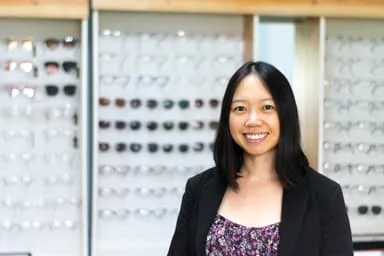
15 years of experience as an optometrist and owner of Carina Eye Care, experienced in prescribing the full range of myopia management options.
Written and medically reviewed by Dr Carina Trinh, BOptom · AHPRA Registered (OPT0001663121) · Optometry Australia Member · CCLSA Member · OSO Member · IOA Member.